

Implementing HR outsourcing in the oil and gas industry has become a vital cost-reduction strategy for energy operators expanding across complex international markets. The oil and gas sector is among the most capital-intensive industries in the global economy. From deep-water exploration and drilling to refining, logistics, offshore engineering, and facility maintenance, companies face relentless pressure to minimize operating expenditures while maintaining strict safety standards, productivity, and statutory compliance.
While asset managers focus heavily on procurement and field operations, human resource administration remains a major source of hidden cost inflation. Recruiting certified technical personnel, processing complex multi-currency payrolls, administering rotational offshore benefits, managing expatriate work permits, and navigating local content laws consume significant capital and leadership bandwidth.
By leveraging HR outsourcing in the oil and gas industry, forward-thinking energy companies shift away from fragmented internal systems. Outsourcing key workforce administrative duties to a specialized partner cuts overhead, improves operational agility, reduces non-compliance penalties, and lets core technical teams focus on field execution.
What Is HR Outsourcing in the Oil and Gas Industry?
HR outsourcing involves transferring selected human resources and workforce administration functions to an external service provider with the systems, personnel, and local expertise required to manage them.
In the oil and gas sector, this can be particularly valuable because workforce requirements often change according to exploration campaigns, construction projects, drilling schedules, production requirements, maintenance activities, and turnaround projects.
Maintaining a large permanent HR infrastructure designed to handle peak workforce requirements can create unnecessary costs during periods of lower activity.
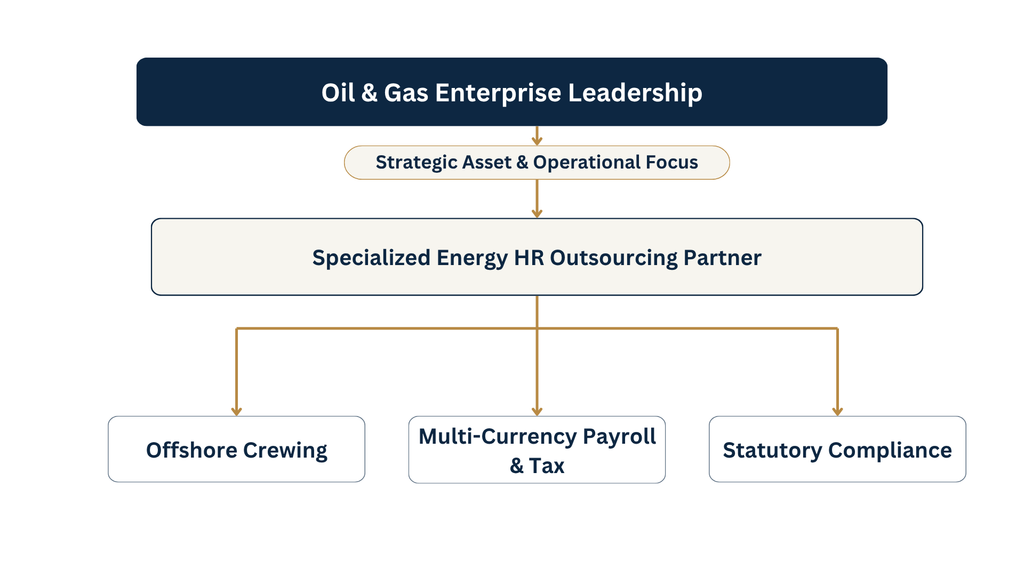
A specialized HR outsourcing partner can support functions such as:
- Technical recruitment and workforce staffing
- Employer of Record (EOR) and local employment support
- Payroll processing and tax administration
- Employee onboarding and documentation
- Offshore crew and workforce coordination
- Expatriate immigration and work-permit support
- Employment and statutory compliance administration
- Benefits and employee administration
The objective is not necessarily to outsource the entire HR function. Instead, companies can outsource the activities where an external provider can deliver greater efficiency, specialist expertise, or scalable infrastructure.
Energy operators utilize Global Staff Management Services to access specialized external expertise exactly when and where projects demand it. Industry benchmarks published by the Society of Petroleum Engineers (SPE) highlight that agile workforce management is crucial for maintaining margins in volatile energy markets.
1. Reduce HR Costs in Oil and Gas Recruitment and Technical Onboarding
Recruiting qualified oil and gas personnel is more complex than hiring for many conventional corporate positions.
Roles such as drilling personnel, engineers, marine officers, NDT technicians, HSE professionals, and other specialized technical workers may require specific qualifications, certifications, medical clearances, safety training, and relevant field experience.
Managing the entire recruitment process internally can involve significant expenditure on sourcing, advertising, screening, background checks, credential verification, interviews, and onboarding.
A specialized recruitment and staffing partner can streamline these activities by providing access to established talent networks and recruitment expertise.
Outsourcing can help reduce:
- Recruitment advertising and sourcing costs
- Internal HR time spent screening candidates
- Administrative costs associated with credential verification
- Delays in mobilizing qualified personnel
- The financial impact of unsuitable hires
For time-sensitive projects, faster access to qualified personnel can also reduce the risk of operational delays.
2. Lower Internal HR Administrative Overhead
Not every HR activity requires a large in-house team.
Routine responsibilities such as maintaining employee records, processing documentation, administering benefits, responding to employee queries, managing leave records, and coordinating onboarding can consume considerable management time.
Outsourcing these administrative functions allows internal HR teams to focus more heavily on strategic priorities, including:
- Workforce planning
- Employee development
- Succession planning
- Leadership development
- Performance management
- Employee retention
For companies experiencing rapid workforce growth, outsourcing can also reduce the need to continuously expand internal administrative headcount.
3. Reduce HR Costs in Oil and Gas Payroll and Workforce Administration
Payroll in the oil and gas industry can be considerably more complex than standard corporate payroll.
Companies may have employees and contractors working across different jurisdictions, currencies, work schedules, compensation structures, and employment arrangements.
Common sources of payroll complexity include:
| Payroll factor | In-house challenge | Potential outsourcing benefit |
|---|---|---|
| Rotational schedules | Managing overtime, allowances, offshore rates, and working patterns | Standardized payroll processes and time-management systems |
| Multiple currencies | Managing exchange rates and international payments | Access to established multi-currency payroll infrastructure |
| Expatriate employees | Managing local payroll and applicable tax obligations | Local payroll and compliance expertise |
| Contractors and employees | Maintaining appropriate employment classifications | Structured contracts and workforce administration |
| Multiple jurisdictions | Managing different statutory requirements | Localized payroll processes and compliance support |
An established payroll provider can give companies access to payroll technology, experienced personnel, and standardized processes without requiring the company to build and maintain all of this infrastructure internally.
The result can be fewer administrative errors, more efficient payroll processing, and greater visibility over workforce expenditure.
Managing complex payroll internally requires expensive software licenses, dedicated international accounting staff, and constant legal oversight. Utilizing Payroll and Tax Management Services delivers scalable payroll infrastructure that eliminates miscalculations, avoids wire delays, and protects profit margins.
4. Mitigating Expensive Regulatory and Compliance Risks
Compliance is one of the most important considerations when managing an oil and gas workforce.
Companies may need to comply with employment legislation, payroll and tax requirements, immigration rules, social security obligations, local-content requirements, and industry-specific regulations depending on the jurisdictions in which they operate.
Failure to meet applicable requirements can result in:
- Fines and penalties
- Back-tax liabilities
- Employment disputes
- Delays in workforce mobilization
- Work-permit or immigration complications
- Operational disruption
- Reputational damage
Outsourcing does not transfer ultimate legal responsibility away from the client, but a qualified third-party HR provider can help reduce administrative and compliance risks by maintaining appropriate processes, documentation, reporting, and statutory submissions.
This is particularly valuable when a company enters a new market where it lacks an established local HR and compliance infrastructure.
An experienced HR outsourcing provider acts as an expert compliance shield. They ensure all employment documentation, statutory pension contributions, social security remittances, and health insurance policies strictly comply with local labor laws and guidelines aligned with International Labor Organization (ILO) standards.
Furthermore, keeping operations fully aligned with international standards established by the International Association of Oil & Gas Producers (IOGP) protects the firm’s global brand reputation.
5. Manage Expatriate Workforce Costs More Efficiently
Oil and gas projects often require specialized personnel to work outside their home countries.
Managing an expatriate workforce can involve employment contracts, immigration documentation, work permits, tax administration, accommodation, benefits, medical arrangements, travel coordination, and other mobility-related requirements.
Delays in obtaining the necessary authorization for an employee to enter or work in a country can affect project schedules and increase costs.
An experienced workforce or immigration support provider can coordinate these administrative processes and help companies manage expatriate deployment more efficiently.
This can be particularly useful for companies entering a new market without an established local HR or mobility team.
Filing errors or visa processing delays can prevent key technical personnel from entering the country on schedule, stalling multimillion-dollar operational timelines. Utilizing professional Immigration Support Services ensures smooth, fully compliant expatriate mobilization without the need to maintain specialized internal immigration and legal teams.
6. Scale Workforce Costs With Project Demand
Oil and gas workforce requirements can change significantly throughout the project lifecycle.
A company may require a large workforce during exploration, construction, drilling, commissioning, or maintenance and substantially fewer personnel during periods of stable production.
For example:
Exploration → Scale technical and field personnel
Construction → Expand workforce administration and payroll
Production → Optimize permanent staffing levels
Turnaround → Support temporary workforce requirements
Maintaining an internal HR structure sized for peak workforce requirements can result in unnecessary costs during quieter periods.
Outsourcing allows companies to access workforce infrastructure based on their operational requirements rather than building every capability internally.
This flexibility can make HR expenditure more closely aligned with actual workforce demand.
7. Reduce HR Technology and Infrastructure Costs
Effective workforce management increasingly depends on technology.
Companies may require HR information systems, payroll platforms, employee-management tools, onboarding systems, reporting platforms, compliance tools, and data-security infrastructure.
Building and maintaining these systems internally can involve:
- Software licensing
- System implementation
- IT support
- Maintenance and upgrades
- Data management
- Staff training
- Integration costs
An HR outsourcing provider may already have many of these systems in place.
Instead of investing heavily in building an entire HR technology infrastructure internally, an oil and gas company can access established systems through its outsourcing arrangement.
This can reduce the technology and administrative burden associated with workforce management.
8. Reduce Employee Turnover and Replacement Costs
Losing experienced technical personnel is exceptionally costly in the energy sector. Replacing a specialized engineer or certified offshore operator involves substantial recruitment expenses, onboarding time, safety orientations, and lost productivity during the knowledge transfer phase.
Outsourced workforce partners help reduce turnover by ensuring:
- On-time, accurate salary disbursements in agreed currencies
- Competitive, locally tailored health and insurance benefit packages
- Transparent contract terms and structured grievance management
- Dedicated local HR support for remote and offshore field personnel
Providing a supportive employee experience builds workforce loyalty, protects field safety standards, and retains specialized technical knowledge within the organization.
9. Directing Capital to Core Assets Through HR Outsourcing in the Oil and Gas Industry
The overarching strategic benefit of adopting HR outsourcing in the oil and gas industry lies in opportunity cost management. Executive leadership teams should direct their time, energy, and capital toward core revenue-generating assets rather than administrative overhead.
Energy executives need to concentrate on:
- Accelerating field development and production volumes.
- Optimizing reservoir recovery and asset integrity.
- Managing capital allocation and corporate growth strategies.
- Securing strategic joint ventures and field licenses.
- Maintaining rigorous HSE (Health, Safety, Environment) operational records.
Outsourcing non-core human resource administration frees up management bandwidth, allowing leadership teams to keep their primary focus on core business objectives.
10. Gain Access to Specialized Oil & Gas Workforce Expertise
Building an internal team with expertise across recruitment, payroll, immigration, employment compliance, offshore workforce administration, and local employment requirements can be expensive.
A specialized workforce partner allows companies to access a broader range of expertise without necessarily building every capability internally.
Depending on the provider and the scope of the engagement, this may include expertise in:
- Technical recruitment
- Offshore workforce management
- Payroll administration
- Employment compliance
- Expatriate mobility
- Local workforce requirements
- Employer of Record services
- Employee administration
For companies operating across multiple markets, this combination of local knowledge and centralized workforce support can simplify international expansion.
In-House HR vs. Outsource Workforce Model Comparison
| Operational Metric | Internal In-House HR Model | Outsourced Energy HR Model |
|---|---|---|
| Cost Structure | High fixed administrative salaries & software licenses | Flexible operational cost tied to active headcount |
| Market Entry Speed | Slow (Requires 3–6 months for local HR setup) | Rapid (Deploy teams in days via existing EOR frameworks) |
| Regulatory Risk | Assumed entirely by the internal operating entity | Shared and mitigated by localized compliance experts |
| Scalability | Rigid; difficult and costly to downsize post-project | Highly flexible; scales seamlessly with campaign cycles |
| Industry Specialization | Varies based on individual internal hires | Immediate access to dedicated oil and gas HR experts |
Partnering with Kharis Petroleum Resources
Managing a global workforce in demanding energy environments requires a partner that combines local operational footprint with international management standards.
Kharis Petroleum Resources & Investments provides integrated workforce solutions tailored specifically for the energy and maritime sectors. Our capabilities include:
- Global Staff Management Services: Seamless cross-border HR and talent retention strategies.
- Recruitment & Staffing: Targeted placement of certified onshore and offshore technical personnel.
- Employer of Record (EOR): Rapid market entry and fully compliant employment management without local entity setup.
- Payroll & Tax Management: Multi-currency, fully compliant payroll administration.
- Immigration & Expatriate Support: Complete visa, quota, and work permit coordination.
- Offshore Support Services: Dedicated logistics, crewing, and regulatory compliance for deep water assets.
By consolidating workforce operations under a single specialized partner, energy companies reduce operational friction, maintain 100% compliance, and optimize operational expenditures.
Frequently Asked Questions
1. How does HR outsourcing in the oil and gas industry reduce fixed operational costs?
It converts fixed internal administrative expenses—such as HR staff salaries, software licensing, and legal retainers—into a flexible, operational cost that scales directly with your project headcount and operational cycles.
2. Can foreign energy companies hire offshore personnel without establishing a local subsidiary?
Yes. By utilizing an Employer of Record (EOR) partner, foreign firms can legally employ local and international personnel, process compliant multi-currency payroll, and remit statutory taxes without registering a local corporate entity.
3. How do outsourcing partners ensure compliance with local content laws?
Specialized energy HR partners track local content quotas, manage statutory training and technology transfer metrics, and file accurate reports with national energy boards (such as NCDMB and NUPRC) to keep operations fully compliant.
4. What HR functions are most commonly outsourced by energy operators?
The most frequently outsourced functions include technical recruitment, multi-currency payroll processing, statutory tax remittances, expatriate immigration quota management, and offshore crew logistics.