

Understanding how foreign companies can legally employ workers in Nigeria is one of the most critical operational questions facing international businesses expanding into West Africa. With a population exceeding 220 million people and rapidly growing technology, manufacturing, financial services, and energy sectors, Nigeria offers access to one of the continent’s largest and most dynamic talent pools.
However, hiring personnel in Nigeria involves more than identifying qualified local candidates. International firms must navigate corporate registration requirements, employment regulations, local payroll obligations, tax laws, immigration rules, and statutory employee benefits. Failing to observe these regulations can expose expanding businesses to severe financial penalties, corporate tax liabilities, legal disputes, and reputational harm.
Fortunately, well-established legal pathways exist that allow overseas enterprises to hire local talent while maintaining full compliance. Whether through local corporate incorporation or an Employer of Record (EOR), understanding how foreign companies can legally employ workers in Nigeria is key to establishing a high-performing, sustainable workforce in the region.
How Foreign Companies Can Legally Employ Workers in Nigeria Through Local Incorporation
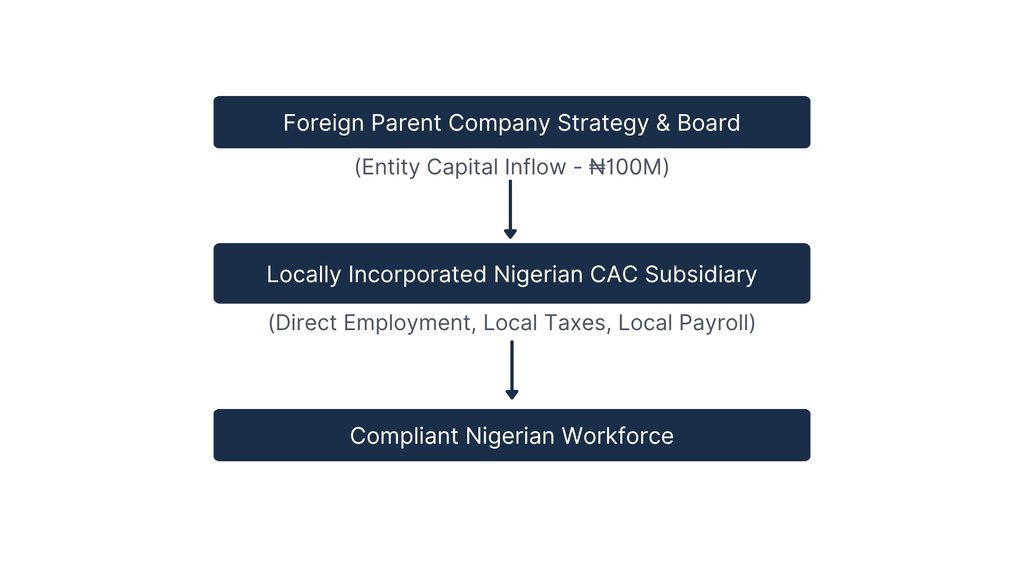
One of the most traditional methods when evaluating how foreign companies can legally employ workers in Nigeria is establishing a locally registered corporate subsidiary. Under the Companies and Allied Matters Act (CAMA), foreign businesses intending to conduct commercial operations in Nigeria are required to register a local company through the Corporate Affairs Commission (CAC).
The CAC utilizes the AI-powered i-CRP (Company Registration Portal), which mandates multi-factor authentication (MFA) and automated annual returns filing. Once incorporated, the subsidiary becomes a recognized legal entity capable of conducting business, entering contracts, processing local payroll, and directly hiring employees.
Benefits of Local Incorporation
Establishing a local subsidiary offers several strategic advantages for long-term expansion:
- Direct Employment Contracts: Issue localized employment contracts directly under your brand name.
- Domestic Banking Access: Open local corporate bank accounts to execute transactions in Nigerian Naira (NGN).
- Bidding Eligibility: Participate in government tenders and satisfy local content thresholds for specialized industries.
- Enhanced Market Credibility: Build strong institutional trust with local vendors, banks, and regulatory bodies.
- Full Operational Control: Maintain total authority over corporate culture, internal security, and physical infrastructure.
For organizations planning significant long-term investments in heavy industries like oil and gas, manufacturing, construction, or financial services, assessing how foreign companies can legally employ workers in Nigeria via direct incorporation provides the most durable operational foundation.
Registration Process and Foreign Share Capital Requirements
The incorporation process begins with a name reservation on the CAC portal, drafting the Memorandum and Articles of Association (MEMART), and registering with the Federal Inland Revenue Service (FIRS) to obtain a Tax Identification Number (TIN).
Under regulations enforced by the Ministry of Interior and the Nigerian Investment Promotion Commission (NIPC), any company with foreign equity participation must maintain a minimum paid-up share capital of ₦100,000,000 (One Hundred Million Naira). Additionally, foreign entities must pay a stamp duty fee of 0.75% on their authorized share capital during registration.
To navigate these initial steps smoothly, expanding enterprises frequently utilize specialized Tax Management Services in Nigeria to handle early corporate filings and protect starting cash flow.
Challenges of Local Incorporation
While local incorporation provides long-term operational autonomy, it introduces administrative overhead:
- High Initial Capital Commitments: Satisfying the ₦100 million share capital threshold requires substantial up-front funding.
- Tax Liabilities: Local subsidiaries are subject to Nigerian Companies Income Tax (CIT) on global income generated by the local entity.
- Ongoing Reporting Burden: Entities must submit annual CAC returns, audited financial statements, and monthly tax filings.
- Direct Employer Liability: The local subsidiary assumes full legal liability for employment disputes brought before the National Industrial Court of Nigeria (NICN).
How Foreign Companies Can Legally Employ Workers in Nigeria Using an Employer of Record (EOR)
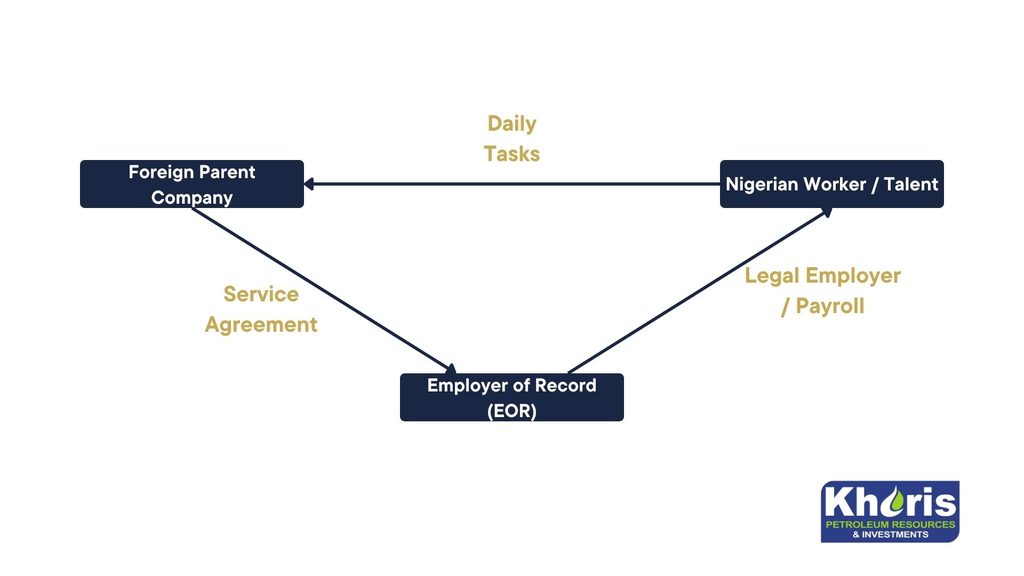
For businesses seeking a faster, lower-risk entry strategy, using an Employer of Record (EOR) offers a practical alternative. An EOR acts as the legal employer of local personnel on behalf of the foreign firm. While the EOR assumes legal responsibility for payroll processing, tax remittances, and employment compliance, the foreign company retains complete control over day-to-day work assignments and performance standards.
How the EOR Model Functions
When analyzing how foreign companies can legally employ workers in Nigeria via third-party infrastructure, the operational workflow functions as follows:
- The EOR executes a fully compliant, local employment agreement with the selected candidate.
- The EOR processes monthly payroll, handles currency conversions, and distributes net salaries.
- The EOR calculates and remits all statutory payroll taxes and contributions to federal and state authorities.
- The EOR coordinates statutory benefits, medical coverage, and worker compensation funds.
- The foreign firm manages the employee’s daily responsibilities, deliverables, and performance goals.
Advantages of the Employer of Record Model
- Rapid Market Entry: Onboard local talent in days rather than waiting months for entity incorporation.
- Zero Local Incorporation Requirements: Eliminate the need for ₦100 million in share capital or domestic subsidiary registration.
- Transferred Compliance Risk: The EOR partner assumes structural liability for local labor law compliance and payroll accuracy.
- Flexibility: Test market potential or run short-term projects before making long-term capital commitments.
Outsourcing administrative employer duties allows international firms to hire top remote professionals as part of growing Remote Work Trends in Africa. Leveraging The Benefits of Outsourcing Business Operations enables management teams to focus on commercial expansion while leaving local compliance to established on-the-ground experts.
Tax Compliance for Foreign Companies Employing Workers in Nigeria
Tax compliance is a core consideration when evaluating how foreign companies can legally employ workers in Nigeria. Employers are legally required to deduct, withhold, and remit all applicable employee taxes and statutory contributions to the relevant revenue boards.
1. Pay-As-You-Earn (PAYE) Personal Income Tax
Under the Personal Income Tax Act (PITA), employers must operate a Pay-As-You-Earn (PAYE) system. Personal income tax is deducted directly from employee gross salaries on a progressive scale ranging from 7% to 24%, depending on total earnings. Monthly remittances must be submitted to the relevant State Internal Revenue Service (SIRS) by the 10th day of the following month.
2. Statutory Pension Contributions
Under the Pension Reform Act, statutory retirement contributions are mandatory for organizations employing 3 or more staff. Statutory contributions are calculated based on monthly emoluments (basic salary, housing allowance, and transport allowance):
- Employer Contribution: Minimum of 10% of monthly emoluments.
- Employee Contribution: Minimum of 8% of monthly emoluments.
These funds must be remitted monthly to the employee’s chosen Pension Fund Administrator (PFA).
3. Employee Compensation Scheme (NSITF)
The Employees’ Compensation Act mandates that employers contribute 1% of total monthly payroll to the Nigeria Social Insurance Trust Fund (NSITF). This scheme provides coverage for occupational injuries, illnesses, or workplace accidents and cannot be deducted from employee paychecks.
4. Industrial Training Fund (ITF) & National Housing Fund (NHF)
Employers with 5 or more employees or an annual turnover exceeding ₦50 million must contribute 1% of their total annual payroll to the Industrial Training Fund (ITF) to support national skill development initiatives. Additionally, employees contribute 2.5% of their basic monthly salary to the National Housing Fund (NHF).
5. Mandatory Group Life & Health Insurance
Under current labor compliance standards supported by International Labour Organization (ILO) frameworks, employers with 15 or more employees must maintain a Group Life Insurance policy valued at a minimum of three times the employee’s total annual emoluments. Furthermore, under the National Health Insurance Authority (NHIA) Act, companies with 10 or more staff must provide accredited private health insurance coverage.
Employment Contracts and Labor Laws Governing How Foreign Companies Can Legally Employ Workers in Nigeria
Understanding how foreign companies can legally employ workers in Nigeria requires strict adherence to the principal legislation governing workplace relationships: the Nigerian Labour Act.
Mandatory Written Contracts
Section 7 of the Labour Act requires employers to issue a detailed written contract of employment to the worker within three months of their start date. The contract must explicitly outline:
- Job title, duties, and official employment start date.
- Total remuneration, payment frequency, and allowance breakdowns.
- Applicable statutory minimum wage standards (currently set at ₦70,000 per month gross).
- Working hours, paid leave allowances, notice periods, and termination provisions.
Working Hours, Overtime, and Leave Rights
Standard working hours are typically 40 hours per week across 5 working days. Key statutory leave entitlements include:
- Annual Leave: Minimum of 6 working days of paid annual leave after 12 months of continuous service.
- Maternity Leave: Female employees are entitled to at least 12 weeks of maternity leave with a minimum of 50% pay (with many sectors providing full pay).
- Sick Leave: Paid sick leave is guaranteed for up to 12 working days per year, provided a certified medical report is submitted.
Immigration Rules and Expatriate Deployment
If a foreign business plans to deploy expatriate managers or technical experts alongside local staff, the firm must secure a Business Permit and Expatriate Quota approvals from the Ministry of Interior through the eCitiBiz Portal.
When deploying international experts into technical sectors such as maritime logistics, offshore energy, or infrastructure development, companies must align their workforce planning with specialized Offshore Support Services in Nigeria to remain compliant with local content requirements.
Cost Breakdown: How Foreign Companies Can Legally Employ Workers in Nigeria
When evaluating how foreign companies can legally employ workers in Nigeria, finance departments must calculate the complete Total Cost of Employment (TCE) rather than relying solely on base salaries.
Itemized Employment Cost Factors
To determine total employment expenditures, organizations must account for the following mandatory elements:
- Gross Base Salary: The negotiated base pay provided to the local employee.
- Employer Pension Match: Mandatory 10% employer contribution based on monthly emoluments.
- NSITF Compensation Fund: Mandatory 1% employer levy based on gross monthly payroll.
- Industrial Training Fund (ITF): 1% annual payroll contribution for qualifying organizations.
- Group Life Insurance Premium: Annual insurance coverage policy (valued at 3 times annual salary).
- Mandatory Healthcare Coverage: Private health insurance premiums under NHIA regulations.
- EOR Service Fees (If Applicable): Monthly management fees charged by an Employer of Record partner.
Local Incorporation vs. Employer of Record Cost Comparison
| Cost & Operational Category | Local Incorporation Path | Employer of Record (EOR) Path |
|---|---|---|
| Initial Capital Requirement | High (Requires ₦100M minimum share capital) | Zero local entity capital requirements |
| Time-to-Hire | Slower (Requires 2–4 months for entity setup) | Rapid (Onboarding completed in 48 hours to 5 days) |
| Tax & Payroll Processing | Managed internally via local finance teams | Fully managed by the EOR service partner |
| Legal Employer Liability | Assumed directly by the local subsidiary | Transferred to the local EOR partner |
| Ongoing Overhead | High fixed administrative and statutory costs | Variable fee tied to active headcount |
Key Takeaways: Choosing the Right Expansion Path
Determining how foreign companies can legally employ workers in Nigeria depends on your commercial goals, investment horizon, and desired operational scale:
- Choose Local Incorporation if you plan to make large capital investments, open physical offices, participate directly in local tenders, or build a long-term presence exceeding 15–20 full-time employees.
- Choose an Employer of Record (EOR) if you want to enter the market quickly, test sales or technical concepts, hire remote professionals, or deploy staff without committing up-front entity capital.
Frequently Asked Questions
1. Can a foreign company hire employees in Nigeria without registering a local business?
Yes. A foreign company can legally hire local personnel without registering a local business by partnering with an Employer of Record (EOR). The EOR acts as the official legal employer on the ground, handling payroll, taxes, and labor compliance on your behalf.
2. What is the minimum share capital required for foreign companies in Nigeria?
Foreign-owned companies registering a local subsidiary in Nigeria must maintain a minimum paid-up share capital of ₦100,000,000 (One Hundred Million Naira), as mandated by the Ministry of Interior and NIPC guidelines.
3. What are the mandatory payroll taxes for employers in Nigeria?
Employers must deduct and remit Pay-As-You-Earn (PAYE) personal income tax (7% to 24%), contribute 10% to the statutory pension scheme, contribute 1% to the NSITF workplace injury fund, and pay 1% to the Industrial Training Fund (ITF) if eligible.
4. How quickly can a foreign firm hire staff in Nigeria using an EOR?
Using an Employer of Record, a foreign company can complete candidate onboarding, contract execution, and payroll setup within 48 hours to 5 business days, compared to several months required for entity incorporation.