

Utilizing comprehensive global staff management services has become a vital strategic requirement for modern mid-market and enterprise organizations scaling across international borders. In the highly integrated global economy of 2026, corporate growth is no longer restricted by geographic boundaries. Businesses can seamlessly source elite software engineers from tech hubs in Europe, build operational customer support teams in Asia, and deploy highly specialized technical managers to lead energy infrastructure projects across Africa. However, this borderless approach to talent acquisition introduces an incredibly complex web of regulatory challenges.
When an expanding corporation hires personnel in a foreign country, it immediately steps into an intricate, unfamiliar regulatory framework. Every sovereign nation enforces its own distinct labor codes, independent tax brackets, mandatory social insurance frameworks, and strict employee termination protections. Trying to manage these highly localized compliance requirements through an overextended internal human resources department often leads to structural gridlock.
According to global operational research published by the Harvard Business Review (HBR), corporations that attempt to navigate international employment laws without localized infrastructure face a significantly higher rate of statutory audits, financial penalties, and operational delays. To build a secure, scalable foundation for international expansion, modern enterprise leaders are turning away from manual, in-house administration and fully embracing structured global staff management services. This operational shift ensures that your cross-border teams remain fully compliant with local labor authorities, allowing your executive leadership to focus entirely on driving core business development and market scaling.
The Complex Realities of Cross-Border Employment Regulations
Expanding an operational footprint across international borders involves far more than simply setting up remote digital workspaces and configuring international payroll systems. The primary hurdle for expanding corporations lies in the massive variation between international employment frameworks. A workforce management model that complies perfectly with labor laws in North America can easily violate strict statutory regulations when applied to personnel inside emerging African markets or highly unionized European jurisdictions.
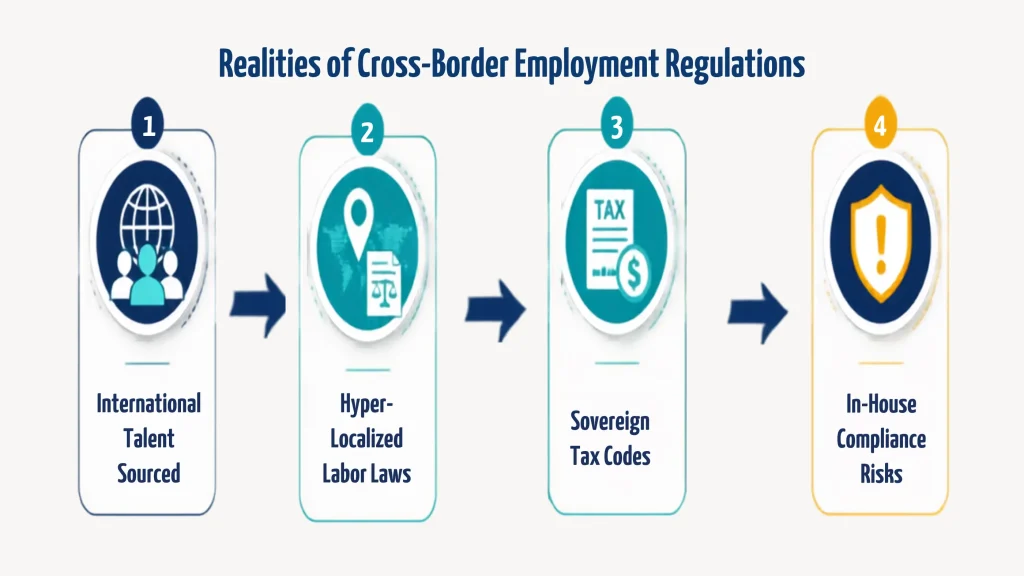
Organizations operating globally frequently misinterpret localized employment regulations, exposing their operations to significant financial and legal liabilities. Common areas of friction include:
- Misclassification of Independent Contractors: Mistakenly treating full-time international workers as independent contractors to bypass local benefit structures can trigger severe retrospective tax audits and heavy labor fines.
- Permanent Establishment (PE) Exposure: Running regular business activities or managing core corporate payroll inside a foreign territory without a localized legal entity can prompt host-nation tax authorities to classify the business as a Permanent Establishment, exposing global corporate revenues to domestic taxation.
- Complex Local Statutory Benefits: Managing intricate localized benefits packages—such as mandatory 13th-month bonuses, regional healthcare levies, and country-specific pension contributions—presents a massive administrative burden for in-house HR staff.
Without access to real-time compliance tracking and deep local expertise, managing a distributed international workforce manually becomes an incredibly risky operational gamble.
Why Global Staff Management Services Prevent Costly Compliance Pitfalls
The primary value of integrating professional global staff management services into your corporate expansion model is the absolute reduction of multi-jurisdictional compliance risks. A dedicated global employment partner acts as an operational shield, providing the localized legal infrastructure needed to support your international workforce without requiring your business to spend months of administrative effort and thousands of dollars establishing foreign subsidiaries.
“True workforce compliance isn’t achieved by reacting to local labor audits after they happen; it requires building a proactive infrastructure that naturally prevents regulatory friction before it impacts your active operations.”
By implementing modern global staff management services, your enterprise transfers all direct employment compliance burdens—including localized tax filings, employment contract drafting, and statutory benefit tracking—to a team of specialized compliance experts. This strategic coordination protects your brand equity and ensures that your cross-border talent feels completely supported from day one.
Strategic Service Integration for Smooth International Expansion
Overcoming the operational obstacles of cross-border growth requires a multi-layered approach to human resource infrastructure. High-performing global companies achieve this by matching their corporate strategy with specialized, outsourced workforce solutions.
1. Transforming Talent Sourcing via Global Staffing Frameworks
Building an elite international team requires a sourcing model that looks past geographic limitations. The modern corporate environment demands highly technical competencies that are often difficult to find within tightly constrained local talent pools.
To safely secure high-performing professionals across new territories, successful operators pair their compliance strategies with comprehensive Staffing & Recruitment Solutions. This integration ensures that your talent acquisition pipelines can instantly identify, verify, and place specialized profiles who align perfectly with both your technical project specs and your unique internal corporate culture.
2. Minimizing Back-Office Friction Through Comprehensive HR Outsourcing
As a distributed workforce grows across multiple time zones and currencies, the daily administrative burden on your internal staff escalates dramatically. Managing multi-currency split payrolls, localized tax withholding compliance, and complex employee leaves requires specialized, hands-on management.
Integrating your back-office systems with dedicated HR Outsourcing Services completely removes this administrative strain. This functional alignment allows your management team to delegate complex daily operational tasks to specialized global human resource professionals, transforming your HR setup from an administrative bottleneck into a lean profit-enabling engine.
Evaluating Operational Models for Cross-Border Talent Deployment
The table below outlines the core operational and financial differences between managing workforce compliance through an internal human resource department versus utilizing professional global staff management services:
| Operational Dimension | Internal HR Department Management | Dedicated Global Staff Management Services |
|---|---|---|
| Speed-to-Market Yield | Slow deployment (typically requiring 3 to 6 months for local entity setup). | Agile deployment with cross-border talent onboarding completed within 48 to 72 hours. |
| Tax Risk Insulation | High exposure to localized Permanent Establishment (PE) audits and tax compliance risks. | Complete protection through fully compliant local employment structures and regulatory compliance. |
| Contractual Accuracy | Variable compliance with a higher likelihood of contract errors due to changing labor regulations. | 100% locally compliant employment contracts prepared and verified by regional legal experts. |
| Statutory Benefit Routing | Manual administration of pensions, healthcare, taxes, and statutory benefits with increased risk of processing errors. | Automated management of payroll, pensions, insurance, healthcare, taxes, and statutory remittances across jurisdictions. |
| Operational Overhead | High capital expenditure required to establish and maintain foreign subsidiaries and HR infrastructure. | No entity setup costs with transparent, predictable monthly service fees and significantly reduced administrative burden. |
Successfully moving highly skilled technical teams across international borders requires a meticulous approach to global mobility logistics. When evaluating the overall impact of global staff management services, managing complex immigration pipelines, work permit allocations, and residency registrations remains a top operational priority for corporate executives. According to research findings shared by the Society for Human Resource Management (SHRM), unexpected delays in securing valid work visas are among the primary causes of project delivery friction for companies scaling across international markets.
To prevent costly operational delays at international border checkpoints, expanding organizations rely on dedicated Immigration Support Services. This proactive coordination ensures that every phase of the crew mobility lifecycle—from initial entry visa applications and local expatriate quota tracking to managing residence permit extensions—is executed with complete accuracy. By taking control of these immigration dynamics, expanding businesses protect their valuable workforce from administrative friction, keeping vital international projects strictly on schedule.
Continuous Compliance Tracking as a Sustainable Business Advantage
Ultimately, the long-term value of professional global staff management services extends far beyond simple back-office document filing. It functions as a powerful tool for cultural optimization and sustainable retention. As highlighted in global workspace engagement analytics published by Gallup, international employees who receive accurate, on-time payments and operate under clear, legally compliant employment structures demonstrate significantly higher levels of long-term workplace engagement and organizational loyalty.
When your underlying workforce management frameworks are supported by proven, regional experts, your remote teams, field logistics, and technical staff compliance are executed flawlessly. This level of operational coordination completely eliminates deployment delays, safeguards your project timelines, and allows your core leadership team to focus entirely on expanding market share and accelerating organizational profitability.
Conclusion: Securing the Future of Distributed Workforces
In conclusion, utilizing professional global staff management services is no longer just an optional administrative luxury for expanding companies; it is an absolute strategic imperative for managing cross-border workforce compliance and long-term financial security. Attempting to manage the complex, shifting landscape of international labor laws, multi-currency payroll allocations, and sovereign tax codes internally introduces unnecessary risks to your global business expansion.
By partnering with an experienced global employment expert, your enterprise can completely eliminate compliance gaps, optimize cross-border payroll processing, and secure top-tier global technical talent. Embracing this modern operational model ensures that your company can confidently scale its international footprint, accelerate its market expansion timelines, and protect its bottom-line profitability across the entire business lifecycle.