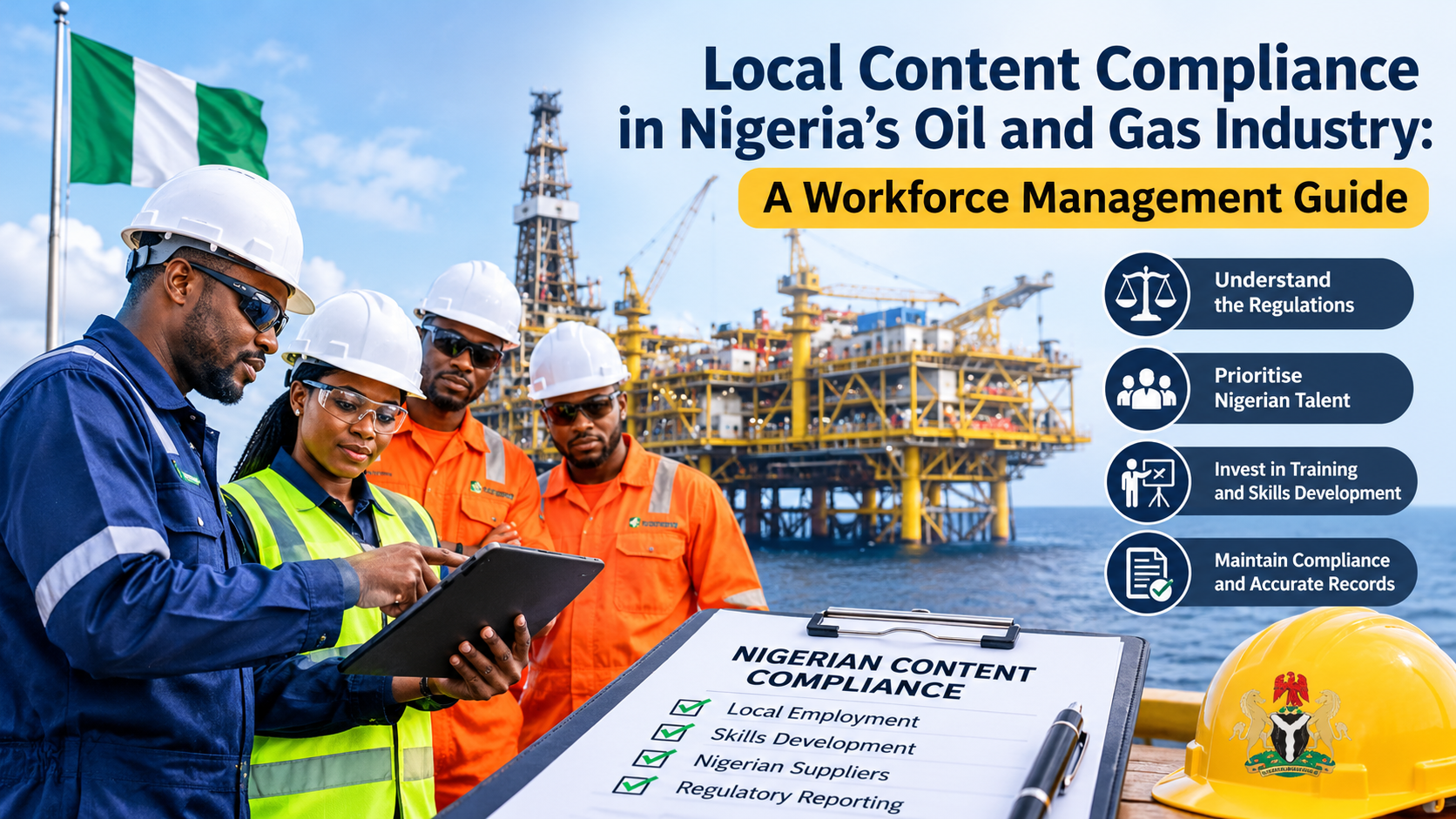
Local Content Compliance in Nigeria’s Oil and Gas Industry: A Workforce Management Guide
By Kharis Petroleum Resources & Investments
Local content compliance in Nigeria is a critical responsibility for companies operating in the country’s oil and gas industry. From recruitment and employee development to expatriate employment, payroll administration and workforce planning, businesses must demonstrate a clear commitment to developing Nigerian talent and strengthening local participation.
Since the Nigerian Oil and Gas Industry Content Development (NOGICD) Act was signed into law in 2010, operators, contractors, subcontractors and other relevant industry participants have been required to integrate Nigerian content into their projects and operations. The legislation established a framework for increasing the participation of Nigerian professionals, businesses, suppliers and service providers in the oil and gas value chain.
For CEOs, HR managers, CFOs and compliance officers, this means that local content is not simply a regulatory issue. It is a strategic business consideration that influences project approvals, workforce costs, operational efficiency and long-term business sustainability.
But what does the law require, and how can companies manage their workforces effectively while meeting these expectations?
This guide explores the key requirements, workforce management implications, common challenges and practical strategies for maintaining compliance in Nigeria’s oil and gas sector.
What Is Local Content Compliance in Nigeria’s Oil and Gas Industry?
Local content compliance in Nigeria refers to meeting the legal and regulatory requirements designed to increase Nigerian participation in the country’s oil and gas industry.
The principal legislation governing this area is the Nigerian Oil and Gas Industry Content Development Act 2010. The Act established the Nigerian Content Development and Monitoring Board (NCDMB), which oversees the implementation of Nigerian content requirements.
The legislation promotes the use of Nigerian personnel, locally manufactured goods, indigenous service providers and Nigerian-owned businesses in oil and gas projects.
In practical terms, companies must demonstrate that they are giving appropriate consideration to Nigerian talent and local capacity when making employment, procurement and project-related decisions.
For workforce management teams, this involves:
- Prioritizing qualified Nigerian candidates when filling available positions.
- Developing local employees through structured training and professional development.
- Creating succession plans for positions occupied by expatriate personnel.
- Managing expatriate employment approvals and related documentation.
- Maintaining accurate employee, payroll and training records.
- Demonstrating progress towards Nigerian workforce development commitments.
The objective is not simply to increase the number of Nigerians on a company’s payroll. It is also to build the technical expertise, leadership capacity and professional experience required to sustain the industry.
Why Local Content Compliance Matters for Oil and Gas Companies
For companies operating in Nigeria, local content compliance should be integrated into business planning from the beginning of a project.
Ignoring regulatory requirements or treating them as an administrative afterthought can create unnecessary operational and financial risks.
Here are some reasons it matters.
1. Supports Project Approvals and Contract Opportunities
The NOGICD Act requires operators to submit Nigerian Content Plans for relevant projects. These plans demonstrate how the company intends to meet applicable Nigerian content requirements.
The NCDMB reviews these plans and issues the relevant authorization where requirements are satisfied. Consequently, companies should consider local content obligations before submitting project proposals or commencing regulated activities. Source: NOGICD Act, Sections 7–10.
NCDMB+1
2. Strengthens Access to Local Talent
Developing a Nigerian workforce can reduce excessive dependence on international recruitment and create a stronger pipeline of skilled professionals.
Companies that invest in local recruitment, technical training and employee development can build teams with the experience needed to support long-term operations.
3. Reduces Workforce and Regulatory Risks
Poorly managed employment documentation, expatriate approvals and succession plans can expose businesses to compliance difficulties.
A coordinated workforce management approach helps companies identify documentation gaps, monitor approval timelines and maintain more reliable employee records.
4. Improves Corporate Reputation
Oil and gas companies are increasingly expected to demonstrate their contribution to local economic development.
A credible local workforce development strategy can strengthen relationships with regulators, clients, suppliers and host communities.
Key Local Content Requirements Companies Must Understand
Understanding the major requirements of the NOGICD Act is essential for business leaders and HR professionals responsible for managing oil and gas personnel.
1. Nigerian Content Plans
Under Sections 7 and 10 of the NOGICD Act, operators are required to submit Nigerian Content Plans for applicable projects.
These plans explain how the company intends to incorporate Nigerian goods, services, employment and training into its operations.
For HR managers, the employment and training components deserve particular attention. Workforce plans should identify the positions required, the availability of qualified Nigerian professionals and the training initiatives needed to address skills gaps.
A well-prepared plan should not simply contain general statements about hiring locally. It should be supported by practical recruitment, training and workforce development activities.
2. Employment and Training of Nigerians
The Act gives Nigerians first consideration for employment and training in the relevant work programs.
Sections 10, 28, 29 and 30 address employment and human capital development requirements. The NCDMB also provides guidance on project-based human capital development and employment and training plans.
Nigerian Content Development & Monitoring Board+1
Companies should therefore establish clear processes for:
- Identifying available Nigerian professionals.
- Advertising vacancies and sourcing qualified local candidates.
- Assessing technical skills and professional qualifications.
- Providing relevant training and development opportunities.
- Monitoring employee progress and training outcomes.
- Maintaining records that demonstrate compliance.
For example, an offshore engineering company recruiting project engineers should assess the availability of qualified Nigerian professionals before relying on international recruitment.
Where skills gaps exist, the business should consider appropriate training and development initiatives to strengthen local capacity.
3. Expatriate Employment and Succession Planning
There are situations where oil and gas companies require specialized international expertise. However, deploying expatriate employees involves specific regulatory responsibilities.
Sections 31, 32 and 33 of the NOGICD Act address succession planning, expatriate positions and the Board’s approval of expatriate applications.
The NCDMB’s expatriate monitoring framework also highlights requirements relating to approved positions, succession plans, understudies, biometric registration and expatriate quota reporting.
Nigerian Content Development & Monitoring Board+1
Companies should pay attention to the following:
- Obtain the relevant NCDMB approval before proceeding with applicable expatriate quota applications to other government agencies.
- Ensure expatriates occupy only approved positions.
- Identify suitable Nigerian understudies where required.
- Develop and implement succession plans.
- Monitor training and understudy progress.
- Maintain accurate expatriate records and submit required returns.
This is particularly important for offshore operations, engineering projects and specialized technical assignments where expatriate expertise may be required.
A succession plan should be more than a document prepared to satisfy a regulatory requirement. It should provide a realistic pathway for transferring knowledge and developing Nigerian professionals.
4. Nigerian Content Development Fund Contribution
Another important requirement concerns the Nigerian Content Development Fund (NCDF).
Section 104 of the NOGICD Act provides for a 1% deduction from applicable contracts awarded in the upstream sector, payable into the Fund.
The NCDF is managed by the NCDMB and supports initiatives aimed at developing local capacity, skills and participation in the industry.
Nigerian Content Development & Monitoring Board+1
Although this obligation is primarily a financial and contractual responsibility, CFOs, procurement managers and compliance teams should ensure that applicable contributions are properly accounted for and documented.
5. Supplier Registration and Nigerian Content Reporting
Companies operating in the sector should also understand the NCDMB’s registration and reporting requirements.
The Nigerian Oil and Gas Industry Joint Qualification System (NOGIC JQS) provides a platform for registering and qualifying relevant industry suppliers and service providers.
Companies should review the applicable registration, procurement and reporting requirements for their projects rather than assuming that every obligation applies identically to every organization.
The NCDMB operational guidelines provide access to guidance covering areas such as contracting, expatriate quota management, human capital development and supplier qualification.
Nigerian Content Development & Monitoring Board+1
How Local Content Compliance in Nigeria Affects Workforce Management
One of the biggest mistakes companies make is treating local content compliance as the responsibility of the legal or procurement department alone.
In reality, it affects the entire employee lifecycle, from recruitment and onboarding to payroll, training and employee separation.
Here is how the major workforce functions are connected.
Recruitment and Talent Acquisition
Recruitment strategies must reflect the requirement to give Nigerians first consideration for relevant employment opportunities.
HR teams should develop sourcing strategies that identify qualified Nigerian professionals before considering international recruitment where appropriate.
This requires access to reliable talent networks, structured candidate assessments and accurate recruitment records.
Kharis supports organizations with staffing and recruitment services, helping businesses source qualified professionals for contract and permanent positions.
Training and Human Capital Development
Recruiting Nigerian employees is only one part of workforce development. Companies must also invest in developing the technical and managerial capabilities needed for demanding oil and gas operations.
Training initiatives may include:
- Technical and engineering training.
- Health, safety and environmental training.
- Offshore operations and safety certification.
- Leadership and supervisory development.
- Mentoring and knowledge-transfer programs.
- Professional certification and skills assessments.
A structured training programme helps businesses strengthen local expertise while supporting succession planning objectives.
Payroll and Statutory Compliance
Payroll management is another important component of effective workforce administration.
Companies must ensure that employee compensation, tax deductions, pension obligations and other applicable statutory requirements are managed accurately.
Poor payroll administration can create employee dissatisfaction, financial reporting problems and avoidable compliance exposure.
For organizations managing Nigerian and expatriate employees, payroll processes should account for the relevant employment arrangements and applicable statutory obligations.
Explore Kharis Global Payroll Management Services for support with payroll administration and workforce payment processes.
Immigration and Expatriate Administration
Expatriate employment requires coordination between workforce planning, immigration documentation and applicable regulatory approvals.
HR teams should monitor work permits, residence documentation, approval conditions and renewal deadlines.
It is also important to distinguish between NCDMB approvals applicable to oil and gas expatriate deployment and immigration approvals or permits administered by other government agencies.
Businesses should ensure that the required approvals are obtained in the correct sequence before deploying international personnel.
Employee Records and Regulatory Reporting
Accurate documentation is essential for demonstrating compliance.
Companies should maintain organized records covering:
- Nigerian and expatriate employee information.
- Recruitment and employment documentation.
- Training and professional development activities.
- Succession and understudy plans.
- Payroll and statutory records.
- Expatriate approvals and relevant immigration documents.
- Workforce reporting and regulatory submissions.
When these records are scattered across different departments, preparing for an audit or regulatory review becomes unnecessarily difficult.
Common Local Content Compliance Challenges in Nigeria
Even established oil and gas companies can experience difficulties managing local content requirements.
Some of the most common challenges include:
Limited Availability of Specialized Local Talent
Certain technical positions require advanced experience, specialist certifications or exposure to complex international projects.
Where the available local talent pool does not meet specific project requirements, companies may need to recruit expatriates while developing local capacity.
Weak Succession Planning
Some organizations prepare succession plans but fail to implement the training and mentoring activities needed to develop Nigerian understudies.
Without measurable progress, succession planning becomes an administrative exercise rather than a genuine workforce development strategy.
Poor Coordination Between Departments
HR, finance, procurement, and immigration and compliance teams may maintain separate records and reporting processes.
This fragmentation can lead to inconsistencies, missed deadlines and incomplete documentation.
Changing Regulatory Requirements
Companies must keep track of applicable regulatory guidelines, approval procedures and reporting expectations.
The NCDMB publishes operational guidelines and regulatory information that businesses should review regularly.
Inadequate Workforce Planning
Recruitment decisions made without considering local content requirements can create problems later in the project lifecycle.
For example, a company that waits until mobilization to identify its Nigerian workforce requirements may face avoidable delays in recruitment, onboarding and training.
Best Practices for Managing Workforce Compliance in Nigeria
Businesses can strengthen their compliance approach by integrating local content considerations into everyday workforce management.
The following practices can help.
1. Integrate local content into workforce planning.
Identify the positions required for each project, assess the availability of Nigerian professionals and determine where training or specialized international expertise may be necessary.
2. Establish measurable recruitment and training objectives.
Set clear workforce development targets and monitor progress through regular HR reports.
3. Link expatriate employment to succession planning.
Where required, identify Nigerian understudies, establish training milestones and document progress towards knowledge transfer.
4. Coordinate HR, payroll and immigration activities.
Ensure that the relevant departments share accurate employee information and monitor important approval and renewal deadlines.
5. Maintain reliable workforce documentation.
Keep recruitment records, employee details, payroll information, training records and regulatory approvals organized and accessible.
6. Conduct regular compliance reviews.
Periodic reviews can help identify expired documentation, incomplete employee records, outstanding training activities and reporting gaps.
7. Work with experienced local workforce partners.
Companies expanding into Nigeria or managing complex projects may benefit from specialist support with recruitment, payroll, immigration and workforce administration.
How Kharis Petroleum Resources & Investments Supports Workforce Management in Nigeria
Meeting local content requirements while maintaining operational efficiency can be demanding, particularly for international oil and gas companies managing large or specialized workforces.
Businesses need more than recruitment support. They need coordinated workforce solutions that connect employment administration, payroll, immigration and people management.
Kharis Petroleum Resources & Investments supports businesses with workforce and professional services designed to simplify operations in Nigeria and other African markets.
Our services include:
- Staffing and Recruitment: Sourcing qualified professionals for technical, managerial, contract and permanent positions.
- Global Payroll Management: Supporting accurate payroll administration and employee payment processes.
- Immigration Support: Assisting with relevant visa, work permit and immigration processes for international personnel.
- Global Staff Management: Supporting HR administration, employee relations and workforce management.
- Employer of Record Services: Supporting compliant employment arrangements where the service model and applicable Nigerian laws permit.
- Offshore Support Services: Providing workforce and operational support for demanding project environments.
Through these services, Kharis helps businesses coordinate important workforce activities, improve administrative efficiency and manage employment-related responsibilities.
It is important to recognize that engaging a workforce partner does not transfer or eliminate a company’s statutory local content obligations. Operators and contractors remain responsible for meeting the requirements applicable to their projects. Specialist support should complement, not replace, the company’s internal compliance oversight.
Frequently Asked Questions About Local Content Compliance in Nigeria
1. What law governs local content compliance in Nigeria’s oil and gas industry?
The primary legislation is the Nigerian Oil and Gas Industry Content Development Act 2010. It establishes the framework for increasing Nigerian participation in employment, procurement, training and other oil and gas activities.
2. Which organization regulates Nigerian content in the oil and gas industry?
The Nigerian Content Development and Monitoring Board (NCDMB) is the principal body responsible for implementing and monitoring the NOGICD Act.
3. Must oil and gas companies priorities Nigerian employees?
The Act provides for Nigerians to receive first consideration for employment and training in relevant oil and gas work programs. Companies should therefore build local recruitment and workforce development into their project plans.
4. Can oil and gas companies employ expatriates in Nigeria?
Yes. Companies may require expatriates for specialized positions, subject to applicable approvals and regulatory requirements. Relevant NCDMB approval, expatriate quota procedures and succession planning obligations must be considered.
5. What is the Nigerian Content Development Fund?
The Nigerian Content Development Fund is a fund established under the NOGICD Act to support Nigerian content development. It is financed through a 1% deduction from applicable upstream contracts.
6. How can HR managers support local content compliance?
HR managers can support compliance through local talent recruitment, employee training, succession planning, expatriate workforce administration, accurate payroll records and organized employment documentation.
Conclusion: Make Workforce Management Part of Your Local Content Strategy
Local content compliance in Nigeria is not simply a regulatory obligation that companies address when preparing for an audit or applying for project approval. It is an ongoing business responsibility that should influence how organizations recruit, train, compensate and manage their employees.
For CEOs, HR managers and CFOs, the priority should be to build a workforce strategy that supports regulatory requirements while maintaining operational efficiency.
By investing in Nigerian talent, implementing practical succession plans, maintaining accurate employee records and coordinating recruitment, payroll and immigration processes, oil and gas companies can strengthen their compliance position and contribute to the development of Nigeria’s energy workforce.