
Analyzing trends in offshore workforce management requires international oil companies (IOCs), independent upstream operators, and maritime drilling service providers to completely re-engineer their human resource architectures for 2026. The technical complexities of deploying highly specialized engineering cohorts onto deep-water platforms, floating production storage and offloading (FPSO) vessels, and remote subsea installations have intensified. Legacy, decentralized administrative pathways are no longer sufficient to support complex cross-border exploration campaigns.
To maintain peak capital efficiency amidst shifting global oil yields, energy leadership teams must adopt structured, asset-light organizational designs. Managing international engineering talent manually through siloed internal departments introduces severe corporate vulnerabilities, including extended mobilization lags, localized tax compliance gaps, and high operational friction.
According to long-term market intelligence published by the International Energy Agency (IEA), upstream energy conglomerates that transition their operational mobility frameworks to localized partners realize a massive reduction in personnel deployment friction. For expanding energy groups, the pathway to sustainable growth lies in replacing rigid legacy models with lean, compliant, and technology-driven corporate ecosystems.
1. The Digital Catalysts Shaping Upstream Operations in 2026
The operational realities of managing technical labour within offshore oil fields demand absolute flexibility and regulatory precision. For decades, traditional human resource departments focused primarily on localized office administration. Today, modern deep-water drilling assets require a highly dynamic model capable of shifting across borders, tracking changing labour codes, and mobilizing specialized engineering teams instantly.
Relying on out-of-date internal workflows exposes upstream exploration brands to compounding layers of financial risk. A minor error in processing a maritime shift differential or miscalculating localized withholding taxes can instantly disrupt active field installations, leading to costly idle crew times, project delivery delays, or heavy statutory fines. These ongoing risks highlight why understanding trends in offshore workforce management has become a vital commercial priority for modern management teams.
2. How EOR Models Intersect with Trends in Offshore Workforce Management
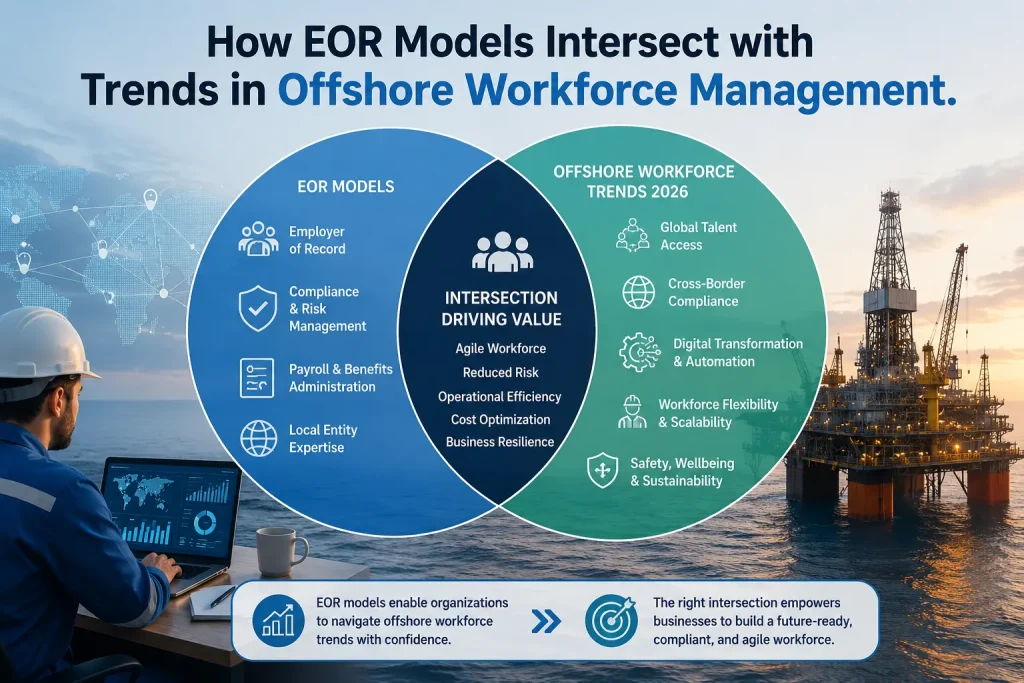
The integration of Employer of Record (EOR) models stands out as one of the most impactful trends in offshore workforce management. An EOR framework functions as a compliant global hiring mechanism, allowing energy conglomerates to legally onboard, manage, and pay technical staff in a new territory without the extreme cost and months of delays associated with establishing a local legal entity.
By working closely with a certified global partner, your business transfers all primary employment liabilities, including local tax routing, statutory benefits administration, and labour union negotiations to a localized corporate entity. This shield effectively mitigates the critical risk of permanent establishment tax exposure, allowing exploration brands to test new offshore basins with lean, agile project teams before committing major capital to local infrastructure setup.
To seamlessly secure elite tier-one professionals across high-yield extraction zones, forward-thinking operators rely on comprehensive Staffing & Recruitment Solutions. This strategic integration ensures that your global talent acquisition pipelines can instantly identify, screen, and deploy specialized engineering profiles who align perfectly with your technical mandates and internal corporate culture.
3. Strategic Compliance Realities Within Emerging Energy Markets
Complex localized regulatory environments make strict compliance the most challenging component of trends in offshore workforce management. In major energy hubs across West Africa, strict guidelines enforce specific local content ratios, mandatory national training allocations, and rigid expatriate quota management.
| Exploration Terrain Category | Typical Regulatory Focus Area | Core Compliance Challenge |
| Onshore Basins | Local community trust funding | Complex domestic labor union negotiations |
| Shallow-Water Blocks | Native supply chain procurement | Strict local tracking of localized servicing parts |
| Deep-Water Projects | Highly technical expatriate ratios | Strict statutory limits on foreign work permits |
Without automated compliance tracking systems, minor discrepancies in reporting can leave your firm exposed to severe penalties, project suspensions, or blacklisting from federal exploration bidding rounds. To build a reliable operational framework, expanding energy companies align their field administration with specialized HR Outsourcing Services. This integration offloads heavy administrative burdens, ensuring that your corporate payroll structures, social security allocations, and localized tax models comply fully with ever-evolving regional labor laws.
4. Technical Mobility: Sourcing Elite Specialized Talent
Sourcing and retaining top-tier technical professionals is an essential baseline for any high-yield offshore project. The energy sector requires rare competencies such as subsea completion engineers, deep water reservoir modelers, and certified offshore safety directors who are often difficult to source within tightly constrained domestic labour markets.
To overcome localized talent shortages, modern exploration frameworks rely on specialized staffing pathways to cycle technical teams through global talent pools without running into compliance roadblocks. According to engineering workforce studies published by the Society of Petroleum Engineers (SPE), data literacy and automation control are now mandatory competencies for field personnel. HR outsourcing allows energy firms to rapidly adjust their training programs to match these emerging technical demands, bypassing the slow internal approval cycles that often delay legacy operations.
5. The Core Role of Dedicated Immigration Support Services
Successfully moving international engineering cohorts across borders requires managing complex immigration pipelines. When evaluating trends in offshore workforce management, securing dependable work permits, entry clearances, and business visas remains a critical priority for project managers.
To eliminate costly logistical bottlenecks at international border crossings, global operators leverage dedicated Immigration Support Services. This proactive approach ensures that every step of the mobility lifecycle from initial visa applications and residence permit processing to tracking critical document extensions is handled with complete accuracy. By taking control of these immigration dynamics, energy companies protect their field personnel from administrative delays, keeping vital offshore operations on schedule.
6. Why Proactive Compliance Defines Trends in Offshore Workforce Management
Ultimately, the future of offshore exploration belongs to operators who treat compliance as a high-yield strategic asset rather than an administrative necessity. As highlighted in global workspace dynamics tracking by Gallup, highly engaged, and structurally supported field workforces display significantly lower accident rates and higher adherence to operational safety standards.
When your underlying workforce management models are fully supported by proven regional networks, your remote teams, field logistics, and technical staff clearances are executed flawlessly. This level of operational coordination eliminates deployment delays, safeguards your project timelines, and allows your core leadership team to focus entirely on extraction yields and geological exploration.
Conclusion
In summary, staying ahead of trends in offshore workforce management is essential for any energy enterprise looking to scale successfully in 2026. Transitioning from heavy, internal administrative structures to specialized EOR, compliant staffing, and expert immigration networks allows exploration leaders to eliminate compliance gaps, optimize payroll processing, and secure top-tier global technical talent. Integrate these modern, asset-light models into your business design, and your company will successfully protect its operational margins while expanding its global footprint.