Table of Contents
- Introduction: The 2026 Energy Crisis
- Global Supply Disruption & Ghana’s Oil and Gas Industry 2026
- The Pump Price Reality: Inflation in Ghana
- Downstream Challenges for Ghana’s Oil and Gas Industry 2026
- Investment Uncertainty in the Upstream Sector **
- The $8 Billion Windfall: Opportunity or Trap?
- Future Energy Security for Ghana’s Oil and Gas Industry 2026
- The Paradox of 2026
- How Kharis Petroleum Resources Supports Businesses
- Conclusion: Navigating High-Growth Markets
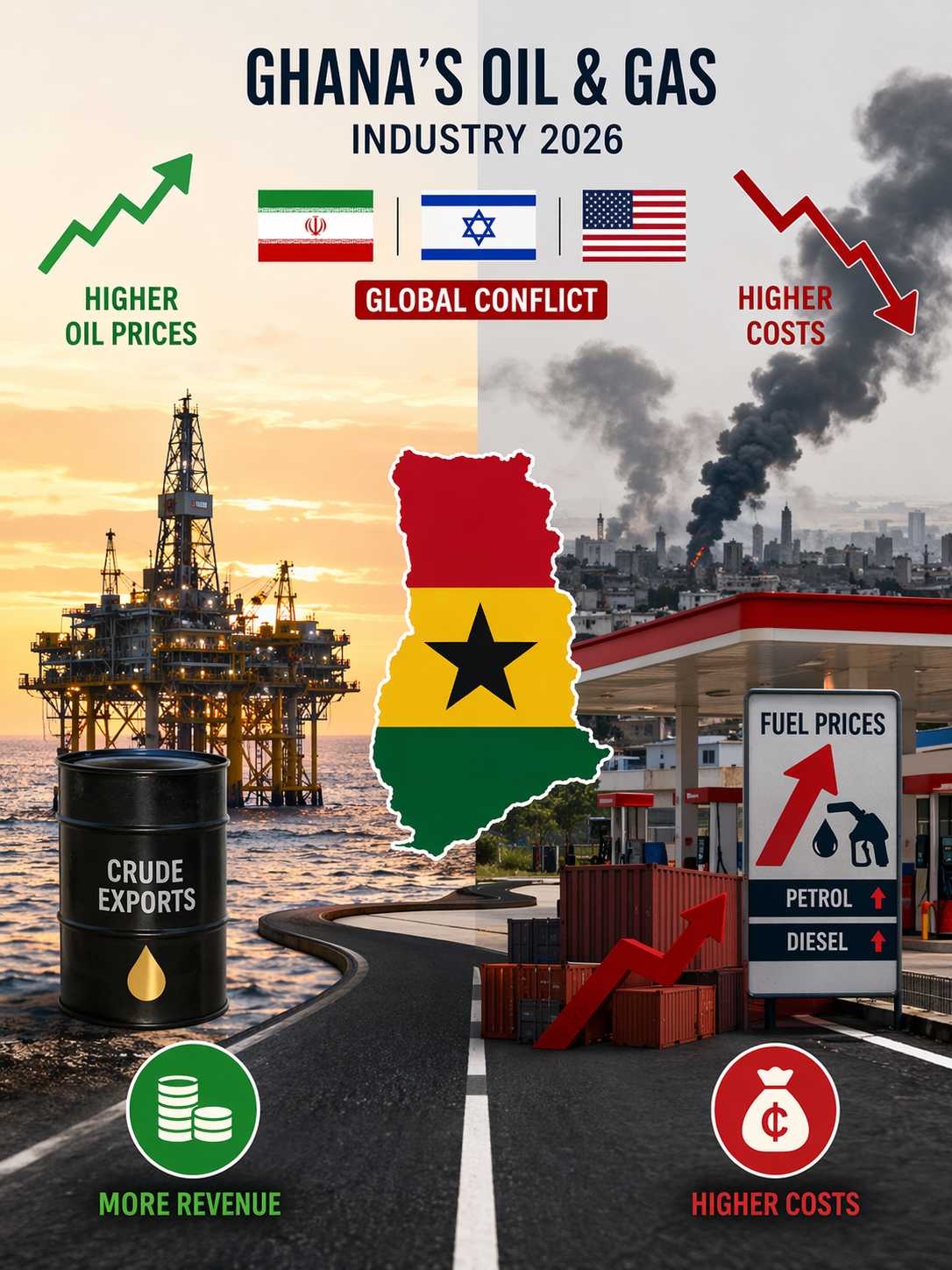
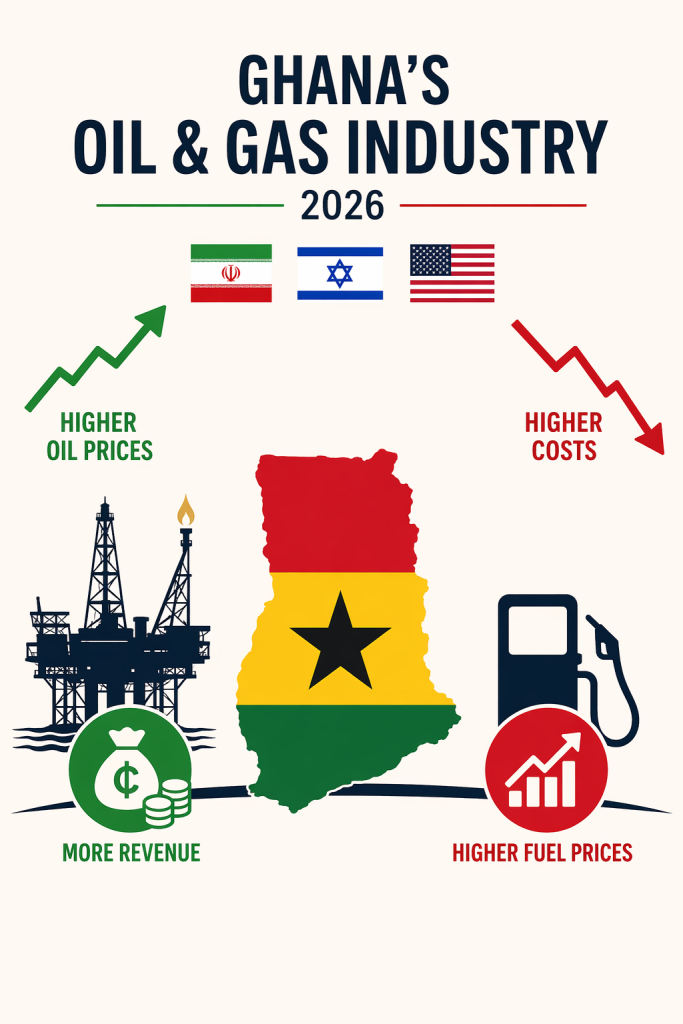
The global energy landscape is currently in the grip of the Iran–Israel–US conflict, a geopolitical firestorm that has fundamentally reshaped the 2026 economic outlook. While the theater of war is thousands of miles away, the “ripple effects” are crashing onto the shores of West Africa. For Ghana’s oil and gas industry, the crisis presents a jarring paradox: record-breaking export revenues set against a backdrop of crippling domestic inflation and structural vulnerability. As we look ahead, understanding Ghana’s Oil and Gas Industry 2026 will be crucial for stakeholders, particularly within the context of the global energy crisis.
1. Global Oil Supply Disruption and Price Volatility
The ongoing shifts present unique challenges and opportunities for Ghana’s Oil and Gas Industry 2026, calling for innovative approaches and sustainable practices. The complexities surrounding Ghana’s Oil and Gas Industry 2026 are further exacerbated by international market fluctuations that affect local economies. The complexities surrounding Ghana’s Oil and Gas Industry 2026 are further exacerbated by international market fluctuations that affect local economies. In this context, Ghana’s Oil and Gas Industry 2026 is set to play a pivotal role in shaping the region’s energy future.
The primary transmission channel for this crisis is the Strait of Hormuz, a narrow chokepoint currently seeing its most significant disruption in modern history. With roughly 20% of global oil supply passing through this corridor, the conflict has sent shockwaves through international markets.
In March 2026, Brent crude prices surged past the $100 per barrel mark, briefly touching $115. For Ghana, this is a double-edged sword. As a producer, Ghana sells crude oil at these premium rates, generating a short-term gain in export revenue. However, the supply shocks are described as the largest in modern oil markets, creating a level of volatility that makes long-term planning nearly impossible.
2. The Pump Price Reality: Inflation Hits Home
Despite its status as an oil producer, the average Ghanaian is feeling the pinch of the war at the filling station. Global price hikes translate directly into local pump prices, with many African nations seeing 30–70% increases in fuel costs. In a bid to shield citizens, the Ghanaian government recently announced an emergency one-month intervention, absorbing GH¢2.00 per litre on diesel and GH¢0.36 on petrol effective April 16, 2026. Despite these efforts, the rising cost of fuel continues to drive:
- Transportation costs: Impacting the price of food and basic services.
- Electricity generation: Increasing the operational overhead for industries.
- Supply chain logistics: Squeezing the margins of local businesses.
3. Ghana’s Downstream Sector: The Achilles’ Heel
The ongoing war has exposed a critical structural weakness: Ghana’s dependence on imported refined petroleum products. While the Sentuo Oil Refinery now supplies approximately 18% of national consumption, and the Tema Oil Refinery (TOR) is undergoing integration to increase throughput to 45,000 barrels per day, the country still relies heavily on the global market for processed fuel. This dependency results in a massive import bill and puts immense pressure on the Ghanaian Cedi. The currency faces constant depreciation risk as more forex is required to purchase increasingly expensive refined products from abroad.
4. Investment Uncertainty in the Upstream Sector
Geopolitical instability often leads to a “flight to safety” among global investors. In the Ghana oil and gas industry, this manifests as increased risk perception.
- Delayed Projects: Major oil companies are reassessing offshore exploration risks.
- High Financing Costs: As global interest rates rise to combat war-induced inflation, the cost of capital for new energy projects has skyrocketed. Industry analysts warn that while the current price hike looks attractive, the underlying instability may lead to slower sector growth in the medium term.
5. The $8 Billion Windfall: Opportunity or Trap?
There is, undeniably, a fiscal silver lining. Projections suggest that the surge in oil prices could net the Ghanaian government an additional GH₵8 billion in revenue this year alone. Historically, commodity booms have boosted African exporters, but this wealth is notoriously volatile. If prices crash following a diplomatic resolution, the resulting fiscal gap could lead to significant economic instability.
6. A Renewed Focus on Energy Security
The 2026 crisis has served as a wake-up call for energy policy reforms. There is now a renewed, urgent focus on:
- Expanding Local Refining: Accelerating the build-out of the Sentuo and TOR facilities.
- Strategic Reserves: Building robust fuel stocks to weather global supply chain disruptions.
- Alternative Energy: Speeding up the transition to gas-to-power and exploring nuclear energy options to insulate the power grid from oil price swings.
The Paradox of 2026
The Iran–Israel–US war creates a stark reality: Ghana earns more from oil exports—but spends even more coping with the economic fallout. While the government’s coffers may swell in the short term, the broader oil and gas ecosystem is being weakened by high operating costs and investment caution. For Ghana, the path forward is clear: to truly benefit from its natural resources, the nation must bridge the gap between crude production and domestic refining, turning a global crisis into a catalyst for energy independence.
Kharis Petroleum Resources Provides Support to Businesses by:
Kharis Petroleum Resources helps businesses navigate the complexities of Ghana’s Oil and Gas Industry 2026 through:
1. Navigating Local Content & Compliance The West African oil and gas industry is heavily regulated by local content laws. Kharis helps international businesses stay compliant by managing:
- Permit & Visa Support: Handling work permits, business visas, and residence permits for expatriate staff.
- Tax Compliance: Ensuring payroll and corporate taxes align with local laws (such as GRA requirements in Ghana) to avoid costly penalties.
2. Workforce Management (Employer of Record – EOR) One of their primary roles is acting as an Employer of Record. This allows a foreign company to hire staff in a new country without legally setting up a local entity immediately.
- Payroll Outsourcing: Managing complex international payroll across multiple currencies.
- Global Staff Management: Handling the HR lifecycle from recruitment to termination, ensuring all labor laws are respected.
3. Operational & Offshore Support For companies in the energy sector specifically, they provide logistical “boots on the ground”:
- Equipment Supply: Coordinating the procurement and supply of specialized tools for upstream activities.
- Logistics & Immigration: Managing the rotation of offshore crews, including transit, housing, and emergency support.
4. Market Entry Strategy They act as “strategy think tanks” for new investors. If a business has a concept for the West African market, Kharis provides the market intelligence and strategic planning needed to transform that idea into a successful local brand.
Conclusion
In a global economy marked by volatility—such as the 2026 energy disruptions—the success of a business often depends on its agility and compliance. Kharis Petroleum Resources plays the role of a “Strategic Bridge.” By absorbing the legal, administrative, and logistical risks of operating in emerging markets, they empower businesses to remain progressive, profitable, and prosperous without being bogged down by the complexities of local bureaucracy. Ultimately, they serve as the operational foundation that allows their clients to unlock the full potential of high-growth markets across Africa and beyond.